Most “team building” activities are a waste of time. We’ve all experienced it: awkward trust falls, forced bowling outings, or costly steak dinners that lead to no real change once everyone goes back to the office. To truly make progress, a team needs to step away from the daily “whirlwind” of emails and meetings to confront the core issues that hold back progress.
The Five-Layer Foundation
A successful off-site isn’t a holiday; it’s about rebuilding the team’s engine using Patrick Lencioni’s model.
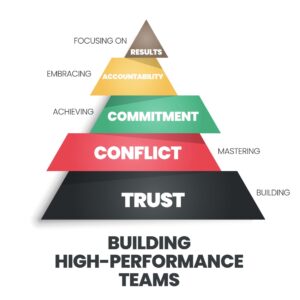
- Trust: This is the foundation. We need to move beyond “predictive” trust—knowing how someone will react—to “vulnerability-based” trust, where team members feel comfortable admitting mistakes, weaknesses, and the need for help.
- Conflict: Without trust, teams experience a “fear of conflict”. Off-sites help teams to engage in productive, honest ideological debates, ensuring that the most important and challenging issues are thoroughly discussed.
- Commitment: Conflict encourages buy-in. A structured workshop ensures that everyone leaves the room aligned on decisions, even if they initially disagreed, because their voices were heard.
- Accountability: On strong teams, the responsibility for performance shifts from the leader to the peers. Team members must be willing to call out each other’s unproductive behaviours and uphold high standards.
- Results: The ultimate measure is collective victory. An off-site helps eliminate individual egos and departmental silos in favour of the shared “thematic goal” that defines team success.
Why You Can’t Do This Alone
You might be a highly skilled leader, but you are also part of the “system.” It is nearly impossible to enable your own team’s breakthrough while also embracing the vulnerability needed to lead it. A professional facilitator provides:
- The “Parking Lot”: During intense sessions, side issues often divert attention. A facilitator uses a “Parking Lot” to record these valid points for future reference, helping the team stay sharply focused on the module’s main goal.
- The Mirror: A facilitator serves as an impartial observer, highlighting unproductive behaviours or “polite” silences in real time that team members might be too reluctant to discuss.
- The Roadmap: Transformation is a process, not a one-time event. A facilitator doesn’t just run a two-day session; they provide a “Teamwork Roadmap” and a “Playbook” to help ensure the commitments made off-site become lasting habits over the next six months.
If your team faces silos, lacks buy-in, or has stagnant results, it’s time to stop the chaos and concentrate on the work. An off-site facilitated session is the fastest way to turn a group of individuals into a high-performing team.